Day 4 of the Reflect and Renew Blog Challenge from Reflective Teacher @TeachThought It's always hard to focus on just one thing! I'm in the middle of preparing to go back into a classroom and a leadership position and I have a list. Not really a surprise as 'everyone' says that a To Do list is a must for getting organised. That's all well and good and I know that, logically, it's a great idea. What if you're one of 'those' individuals who gets easily distracted or, even worse, procrastinates? What if you're both??!! (I'm even getting distracted as I write this).
As I started to think about the one area to develop, I came up with about 30. (Next time I write blog prompts I'll remember that I have to use them too. They do force me to confront my shortcomings though, which is always a good thing.
I've finally settled on the one main area I want to continue to develop and extend this year - using all things Google in my teaching and learning. I've been a fan for a long time but have yet to incorporate Google Classroom into what we do. This is one of the reasons I need to be back in the classroom - so that I can implement all the ideas I've explored over the last year but not been able to fully utilise.
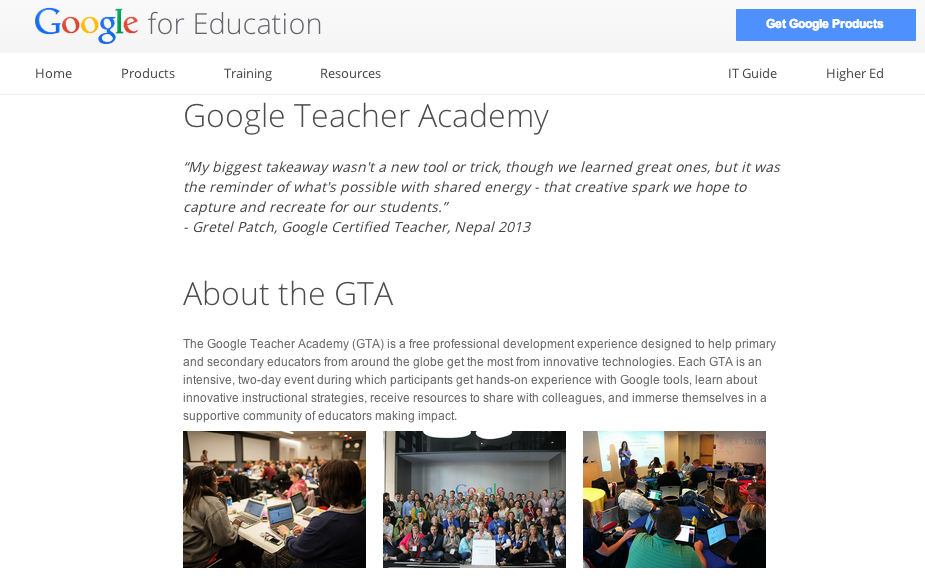
The biggest part of that goal is to apply to participate in the Google Certified Teacher Programme. I'm keeping an eye out for when applications open and will do everything I can to achieve that goal this year. I know through my research the benefits of using Google in the classroom using Google Apps for Education (GAFE), and I'd started to use the tools on a daily basis prior to leaving the classroom at the end of 2013. Time to get back into it! Have a look at the presentation below to get an idea about what it's all about and the advantages.
Day 3 of the Reflect and Renew Blog Challenge from Reflective Teacher @TeachThought
Learning is my passion and I am completely and unapolegetically geeky about it. I know that it sometimes drives people crazy and yes, I do have trouble switching of but that's just me. I try to tame it a little but it always escapes! Even today, as I'm writing this, most of my friends are out at the beach as it's such a glorious summer's day. Where am I? Here, on my laptop, working and learning. Do I resent this, no. It's Day 3 of our blog challenge @TeachThought and I'm extremely excited that this time the prompts have not come just from Beth and me, but also from our community. My final Masters research is around building a living online Community of Practice and I think we're getting somewhere with this. The prompt today threw me into a bit of a spin really, which is my own fault as this is one of mine!! What was I thinking?? There are literally hundreds of things I want to work on in my teaching and learning. Where do I start? What's the most important? How do I prioritise? Woah!! Slow down and focus. I have such a bad habit of wanting to improve on everything or learn new things...yesterday. This is not good for one's health. At all. It can also mean that deep learning doesn't happen and this is what I'm arguing about in my research on teacher professional learning. We do too much in bits and pieces and move rapidly from one professional learning project to the next without really implementing concrete changes that can be sustained. Too often the learners can get lost in this process and by the 'learners', I mean the students AND the teachers. This year I want to continue to explore more of Carol Dweck's and James Nottingham's work around Growth Mindset which will underpin my teaching and learning. Curriculum-wise, I want to really focus on developing the science curriculum in our school. Primary schools tend to not be very strong on Science and it's long been a concern that needs to be addressed urgently. I will work with the school, the community and, most importantly, the students, to develop a strong science learning focus that has all the cross-curricular links to make it relevant and linked to the world outside the classroom. Carol Dweck discusses her research...
James Nottingham on the dangers of labelling our students...
My other focus area will be in leadership as I'm returning to school as a Deputy Principal, a role I've held before but so much has changed in what makes an effective and valuable leader and I want to push myself as far as I can go with this. I will learn from my previous role and the mistakes made and improve on the leader I was then to be the best I can be now. This is not only important for me but it's incredibly important for the school - the staff, students and community. I continue to have so much to learn. That's the fantastic part. I always return to Simon Sinek as one of my guides in this area. He speaks about the 'Why' of what we do and how important it is for everyone to be clear about this, particularly our leaders.
Day 2 of the Reflect and Renew Blog Challenge from Reflective Teacher @TeachThought
A few years ago I had a wonderful student teacher who gave our class a picture for our wall that had this quote on it. It really struck a chord with all of us, me included. She said that she had loved being in our room as we were all so unique, crazy and slightly weird. We saw possibilities and questions in everything! For us, this was an enormous compliment as it meant we were relaxed enough to show our true selves and have fun with the serious business of learning. This had been a group of students who, generally, were not engaged, did not enjoy school and would not really engage in conversation let alone relax and have fun with what they were learning. In some ways, I think they saw me as the 'enemy' - the person who would tell them what to do, what to learn and how to learn it. It was a class I inherited during the year and their first teacher had done a fantastic job to get them to where they were but there was something missing. I spent many hours reflecting on what it was. Was I missing something? Was it a cultural aspect I was missing as these were diverse learners from many different backgrounds; some of them were experiencing very difficult circumstances. The first thing I needed to do was to get to know them as individual human beings. Not as 'the students', not as 'the class'. I told them I did not expect them to respect me - I had to earn that right to be respected - but I did expect that they would be well-mannered and not just get up and walk out of class when they felt like it, etc. The key for me was that they needed to know I had their backs - always and without question. That can make you unpopular when you are backing a student whom you know is telling the truth against a teacher who is not. They also needed to know that I respected and cared for them over and above all else, and no matter how challenging they were to me. It didn't change anything. I am and always will be their champion - just like Rita Pierson says we need to be. She is my inspiration because she helped me understand that what I do and how I think is on the right track. In many ways she validated what I do. Is it unique? I don't think so. I think we all want to be our students' champions. So what happened with this amazing group of young people? I changed their programme, in consultation with them, to incorporate their passions and we became a largely digital class. Their achievement levels shot up dramatically, they came to school more often, (often incredibly early!!), they were passionate about learning and best of all...they were not afraid to be themselves, including being crazy, weird and showing all those great creative beahviours. They had high expectations for themselves as learners. They were so successful and such a tight-knit group that we kept them together for two years, something that had only been done once before and hadn't been altogether successful. I was so proud and priviledged to teach and learn alongside them.
Is that what makes me unique? I don't know. I think it's a collection of 'things' but they are no more than what most teachers will do or want for their students. I've started another list to organise my thinking on this. (Creating a few lists lately - an age thing???). 1. I expect to share the teaching and learning with my students. No 'control freak' here. I learn from and with them. This is my foundation belief and has been with me since I started at University in 1996. 2. Knowing my students as individual human beings - what their passions are, what their needs are - is crucial for me and comes before the academic side in the beginning. I don't believe you can have truly outstandingly successful learners unless they know you know them, believe in them and expect them to achieve with your support. 3. I am often wrong and will happily admit it. It's how we learn, afterall. It's the most powerful learning but we need to be risk-takers to be able to do this. 4. I will always be there for my students, no matter what, no matter how busy I am. I'm their chief cheerleader! 5. I'm passionate about what I do and I'm constantly learning and striving to be better. I have high expectations for my own learning too. It's that growth mindset that Carol Dweck talks about. I expect that for my students too.
Day 1 of the Reflect and Renew Blog Challenge from Reflective Teacher @TeachThought
It's not often we sit down and have to articulate our beliefs about the way we teach and our students learn but I believe it's one of the most important, and often neglected, parts of what we do. I wonder if we take it for granted that we know what we're doing and we do what we do, but it's not until we pull apart the why of what we're doing that we start to perhaps question and challenge those beliefs.
For me it helps me to be a reflective practitioner and to be very clear about what I'm doing and why. Having said that, I think it's also incredibly important to be open to new ideas and ways of thinking and to challenge your beliefs - sometimes on a daily basis - so that you are constantly striving to be the best you can be and to meet the needs of every individual student you come in contact with.
I've started by creating a list and it's one I'll keep returning to, and adding to, this year.
1. Involve the students in the learning process at ALL stages - from planning through to assessment. They are the key part of the process, don't leave them out. Students must be at the heart of everything we do.
2. Listen to your students - Student Voice is one of the most powerful tools we have at our disposal. Discussion in the learning environment is crucial. Silent classrooms where learning is not being created together are not powerful learning environments. Teacher talk needs to be monitored too.
3. Be prepared to be a learner alongside and with your students - "We are all teachers and we are all learners in our learning environment."
4. Embrace and harness the power of technology but be very clear about the learning and teaching first BEFORE including it in your learning and teaching.
5. Learning must be relevant and connected to the world outside the classroom - break down those classroom walls by creating real and relevant connctions. As teachers, we need to be relevant and connected too. Worksheets don't cut it for me.
6. Feedback is key but it needs to be the right kind of feedback - check out a presentation from my Masters research from 2011. They also need time to digest, process and act on the feedback.
7. We need to teach the skills our students need - including the digital ones. Don't assume that they are 'Digital Natives' and can handle all technology willingly and confidently. Yes, they've grown up with it, surrounded by it, but often not with a specific learning focus as critical thinkers and users of
technology in their learning. Help them learn these skills and become confident users of tech.
8. Be careful of how you use praise and of what 'type' you are using. Carol Dweck and James Nottingham are my guides on this.
9. Students - and teachers - must be absolutely clear about what is to be learned and why. They need to be able to articulate this. Clarity in the Classroom is written around this and has taught me so much over the years.
10. Above all, students learn best when they know that you care about and respect them; that you value them as individual human beings and not just as 'the class' or 'the student', etc.
Here's a clip from Carol Dweck which focuses on the Growth Mindset and the role of Praise. The more I read of her work, the more I know I have to keep learning in order to help my students learn best.
Day 22 of the Attitude of Gratitude Reflective Teacher @TeachThought Blog Challenge...
I've been reading through some fantastic posts about family traditions and am feeling a little bit envious! There really are some fantastic ones out there. Check out the beautiful cakes, etc on Mrs Slaviero's blog or the very special traditions of giving from Susan Heydt.
For many years, family traditions in New Zealand for many families, especially those whose heritage is English, Scottish or Irish, centred about traditions brought to this country with our ancestors. We seem to have fiercely hung on to so many of these, particularly the Christmas traditions of our Northern Hemisphere ancestors who are in the middle of very cold winters at this time of year.
This often means we have enormous Christmas dinners with all the trimmings. Hot meals; turkey, ham, new potatoes, peas, etc., followed by traditional pavlova, trifle and Christmas pudding. This is wonderful food, absolutely delicious but...temperatures on Christmas Day in New Zealand can reach into the mid-30s! As for Australia - parts of that fantastic country hit the mid-40s. (Celsius not farenheit!!) Yet, we still persisted with this for so many years because it was, and still is for many, an important family tradition, perhaps a link to our ancestors.
We're starting to change and find our own way as a country and create our own traditions. For many this means a change to this special celebration meal. Many now head to the beach or at least have a barbecue and relax outside with family and friends. Much more sensible!
Pavlova - source of great argument between Australia and New Zealand over who created it. For the record, the Kiwis did! Named in honour of the ballerina Anna Pavlova
What does my family do? We still have the full-on traditional Christmas dinner and celebration. I'm grateful for this tradition as it brings us together. We perhaps need to create some of our own traditions! (I'm still going to bake the Christmas cake in the heat of November and we'll never let go of the Pavlova though!)
Day 21 of the Attitude of Gratitude Reflective Teacher @TeachThought Blog Challenge...
Today we have to choose one book that we're grateful for having read that has changed our practice. Only one??!! Who created these prompts...oh, that's right, we did. (Note to us - make it easier next time). Having said that, focusing on just one book has made me be more analytical and reflective about which book, among the many, I've read that has actually made a sustained impact and changed my practice. A few years ago I moved to one of the best schools I've ever experienced. Professional learning was the expectation as was sharing practice through the Critical Friends programme. I learned so much while I was there and I think I've held onto almost all that new knowledge and developed it further to make a better impact on my students learning - and my own. One of the key books that was being explored by the staff when I arrived was: Clarity in the Classroom by Michael Absolum (I reviewed this for the Reflective Teacher at TeachThought community a few weeks ago). I love the subtitle - 'Using formative assessment, building learning-focused relationships.' It puts the focus firmly on learning. What we explored as a staff was implemented in our learning and teaching as part of the Critical Friends programme which included a strong focus on Action Research. We shared our findings each week and reflected on the changes implemented. It was obvious to hear a change in our shared language and shared focus and it was also clear to see a shift in student learning and achievement. My favourite chapters are "Being clear about what is to be learnt" and "Active reflection about learning." Both chapters have helped me to be a more reflective practitioner and to be clear about what we're learning and why. "Why" is a question I ask myself about everything I do and every tool I use. The whole book ask questions that help you reflect on your practice to ensure that you are providing the best learning environment for both you and your students. It provides examples of effective and not so effective practice and has "Try This" prompts for you to explore as a staff and also in the classroom - fantastic for professional learning discussions. There are so many books which have impacted my practice but this has continued to be one of the most powerful if not THE most powerful.
Day 19 of the Attitude of Gratitude Reflective Teacher @TeachThought Blog Challenge...
For Beth - always curious
A note for a very important person, friend, partner in crime and valued colleague.
In Appreciation of Beth
A few months ago I was running a Twitter Chat as part of my role of developing an online community of practice for TeachThought. An educator by the name of Beth Leidolf joined in that day and from then on a crazy partnership/tag team was born. The power of Twitter! That particular day, our conversation was all about the power of blogging; not just for our students but also as a way of developing reflective teachers and reflective practice.
From that conversation of 140 characters or less, the first TeachThought Blog Challenge was born. We held this in September and the theme was Reflective Teaching and Learning. We had so much fun running this; conversations very late at night or very early in the morning depending on what was going on. The global distance, I'm in New Zealand and Beth's in the US, was nothing. It's been a great example of what globally connected educators can do - especially when they figure out the challenge of the time zones. Factor in the time challenge changes of Daylight Saving etc and the fun begins.
We've both made many new friendships and are constantly being challenged in our thinking by the ideas of others. Beth, you challenge my thinking, keep me on track, have boundless energy and enthusiasm which never fails to rub off on others. Your knowledge and expertise I value immensely and look forward to many years of friendship and collaboration.\
Thank you for everything you do and for being the passionate educator that you are.




.JPG)
